Daily pages of reflection...for knowledge, understanding, to wisdom
Section of The Last Supper, Leonardo Da Vinci Section of The Last Supper, Leonardo Da Vinci

Suffering for Good

Section of The Taking of Christ, Caravaggio, 1602

The passage above provides one of the most helpful insights in Scripture for Christian life.  It challenges the human feeling of justice and fair play, when applied to a personal, even group, context.  If righteousness is not somehow rewarded there is less interest in its stories.  We prefer that the bad guys receive comeuppance and some sort of reward accrue to the good guys. Virtue is its own reward, is a common saying, but experience suggests that the general public doesn’t believe it.  To do good means, in consequence, to be treated well, at least with justice – or doing the good is not perceived as truly rewarding.  If there is no benefit, what difference does our good conduct make? … Read more

More On Hospitality

Section of The Taking of Christ, Caravaggio, 1602

The word hospitality in the New Testament grows out of a Greek prefix related to love (philo).   It denotes meaning related to attitudes, showing friendliness, and may refer to family, associates or neighbors, even strangers.  The attitude is that which develops a fondness for guests, a kind of delight in one’s attitude that relates to good feelings and personal interest in others.  Presumably this interest becomes influential in the insights and conduct of the persons receiving the hospitality.  It affects the human values of the hospitable person or group that may influence spiritual interests and concerns of all.  Hospitality makes and cultivates friends, but is more, much more.  It is means for ministry that makes receiving persons feel they are… Read more

Hospitality

There are four or five books of Scripture that did not seem to me, early in the years of my readings, to be adequately meaningful to the larger story of the Church, the history of the plan of salvation and the motivating relationship of God and man.  One of these was Third John, a short personal epistle written by the Apostle John to his friend, Gaius.  The few verses introduce three names of men about whom John made cryptic remarks: Gaius, the faithful friend whom John commended for his hospitality to traveling Christians, believed to be itinerant missionaries and evangelists; Diotrephes, who is identified as a controller, for prideful motives, in a local congregation, and was not sympathetic to visiting… Read more

Christian

Section of Christ and the Woman of Samaria, Benedetto Luti, 1715-20

Christianity is unique, principally in one factor, in that it is organically relational to God.  Christian faith and life structure emanate from the born again experience that occurs in the action of God in response to the request of a sincere person – that God, in Christ, overcomes the sinful (imperfect) nature of the individual and causes his (Christ’s) mediation to give current, even immortal, spiritual life to the penitent person.  This indwelling of Christ is vital and unique to the understanding of the Christian faith as it is promulgated in Scripture.  It is acknowledged here that many persons who identify themselves as Christians do not believe this declared experience.  Webster’s Dictionary includes, among several generic definitions, the pedestrian concept… Read more

End of Knowledge

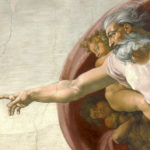
Section of Sistine Chapel ceiling, Michaelangelo, 1508-1512

We all loved Briggs.  Briggs was a Golden Retriever, pet dog of one of my sons.  He was big, docile, obedient, lovable but overweight and useless.  He could not hunt.  He wasn’t a watch dog.  He cowered away from the sound of engines, such as lawn mowers or vacuums.  He would wait for his master inside the truck until he died if the truck were abandoned with windows open.  Having been neutered he could not breed.  Nevertheless, Briggs had large value.  We loved him.  His value in the world was related to the family members and neighbors who cared about him.  That was enough.  (This Page was first written when he was alive.  Old age did him in.) If I… Read more

Day Without Sun

Section of The Infant Jesus and St. John the Baptist, Guido Reni, n.d.

For persons in the northern hemisphere December seems like winter even though it is not the coldest month of the year.  In the southern hemisphere it ushers in summer, the warmest season.  Even in the differences of the hemispheres there is a broad belt on either side of the equator that is fairly mild in winter, not encountering much interference with snow and cold, except on the highest elevations.  December in the northern climes is related to shorter daylight hours, weather that periodically limits human activity, and broken cycles for flora and fauna.  To these natural wonders is added a bleak winter psychology that is partly muted by the rather universal acceptance of a Merry Christmas as a successor for… Read more

Weeping

Section of The Infant Jesus and St. John the Baptist, Guido Reni, n.d.

Santayana, the philosopher/poet, was not a theist.  Theists are usually credible persons who believe in God, God who provides a cause and effect pattern for their lives.  The atheist begins with nothing, and leaps forward in some faith oddity that, at first, disregards his later premises related to cause and effect.  Once the physical world shows up he can use natural logic.  Such a faith, for God believers, appears more difficult than faith premises that hold for a God presence creating origins.  Santayana seems to have stalled in believing that earth system is exclusive. He nagged at various persons he felt serious about life, as to faith in God and immortality. If this God/faith context is true, one accounts for… Read more

Celebrity

Walking in the University District of Seattle one evening during the period when I was engaged in a doctoral program at the University of Washington, my wife and I noted a billboard photo of Marilyn Monroe, a visual image that violated our perception of social propriety.  My wife asked me what would be my prediction about the future of Marilyn Monroe.  I blurted out that I believed she would sicken and die before her time.  I surprise myself and those who know about my off hand prognostications about some celebrities, celebrities who violate social balances and offer unsatisfactory models to society.  I am not comfortable with my feelings about these persons, and try to keep my dark views about the… Read more

Heaven

Section of The Infant Jesus and St. John the Baptist, Guido Reni, n.d.

There is limited information in the Scriptures about the nature of heaven, but there is considerable speculation on earth about what happens to persons after death as relates to any heavenly journey and presumed experience.  The Catholic faithful must deal with purgatory in their transition from earth to heaven.  Some eastern religions teach that the faithful should develop hope that they are good enough to be dissolved in the cosmos and do not have to return again to earth life.  There are the soul sleepers, the deniers, the speculators, annihilators – even those who resist heaven by worshiping Satan.  Wherever Satan may be found, they expect to be there, or to join with those who believe in annihilation of the… Read more

Fasting and Nature

Section of The Infant Jesus and St. John the Baptist, Guido Reni, n.d.

To address failure in the spiritual life of Israel, and by extension into ours, Isaiah used a lengthy illustration related to fasting, and a summary instance related to Sabbath-breaking – in this chapter of the prophecy that bears his name.  His particular point in the fasting narrative is that Israel felt righteous in that the laws of formal fasting had been kept, but the obedience was for show not for genuine faith prayer.  Isaiah’s homily to them was that even though the gestures of fasting had been carried through as outlined in the Law of Moses, the intentional meaning of fasting was overlooked.  This oversight made the formal practice useless.  It were better that no fasting was followed if the… Read more