Daily pages of reflection...for knowledge, understanding, to wisdom
Section of The Last Supper, Leonardo Da Vinci Section of The Last Supper, Leonardo Da Vinci

The Heavens

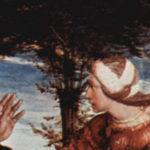
Section of Noli me Tangere by Hans Holbein the Younger

Illusion is related to mystery.  I was sent an email of an entertainer who took silk cloths and turned them, through various simple gestures, into doves, or from doves to silk cloths.  By the time he finished, a cage was full of variously colored doves.  He concluded by throwing one of them into the air. The bird disappeared, showering down a snow storm of white feathers.  My constant thought in viewing the act was: How did he do all this?  My email friend, adept at doing magic acts himself, and sending the recording of the act, was also taken with the same question.  He didn’t know either.  And, the entertainer is not going to tell.  His livelihood may depend upon… Read more

Problem Solving

Section of The Crucifixion, Pedro Orrente, ca. 1625–30

One of the important concerns in life is to become oriented in mind and conduct to problem solving.  In all the relationships of my life, including counseling sessions with troubled persons this orientation has served me very well indeed.  Learning it early on is one of the greatest gifts one can give to self and others.   In this context of problem solving, rather than problem reacting, there appears, even in attitude, a significant shift toward constructive conduct and contentment, perhaps to resolution of issues related to our eternal welfare.  Major to the physical appearance of Jesus in nature’s society was that he would be a problem solver.  We have this attitude in Jesus that is to be characterized in us. … Read more

Wholeness

Section of Christ and the Adulteress, Lucas Cranach the Younger and Workshop, ca. 1545–50

Those who appear to know the most about human beings argue for wholeness, for unity of person/life in the individual.  Context, important in understanding related to the presentations of these Pages, is one way of addressing the matter of wholeness.  I spent some hours watching the Dr. Phil show on television.  Dr. Phil began his media experience on Oprah Winfrey’s popular show.  He proved to be so popular that his segment was spun off into a show he hosted.  It is excellent, educational, and sometimes raw in making the real problems of persons known, understood and addressed.  I have given attention to comparing his humanistic approach (not anti-religious), and the Christian (which supplements secular understanding).  Readers of these Pages know… Read more

Adolescence

Section of The Infant Jesus and St. John the Baptist, Guido Reni, n.d.

I was named after my father, whom I remember seeing once before his death.  I was five years of age.  His influence on me comes only from my responses to the few stories I heard about him.  My father became only a cipher in my life mostly in negative pattern related to the circumstances he left to my mother in the short period they were together before his nearly five years of decline to death caused by tuberculosis.  The story is one of sadness, and my mother’s effort to keep and maintain her children, becomes a story of the determination of a person who refused to accept the outrageous fortune that can be dealt to imperfect persons in an imperfect… Read more

Marriage/Family

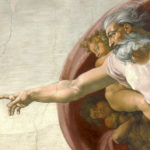
Section of Sistine Chapel ceiling, Michaelangelo, 1508-1512

I return to one of my all-time favorite themes – marriage and the family.  As each human individual is the first unit of interest with God in the creation, so family is the next unit for God with the individual in society.  The primacy of the individual is demonstrated in the creation of Adam, who appears for a time without a mate.  God knows the loneliness of the male, and fills the need with the female.  (Precedence does not determine equality, nor do the role assignments limit the genders.)  In his observations, the first male saw the relationships in the animals, so emphasizing aloneness for him.  The loneliness served well, in that the human male, in a biological gesture from… Read more

Order

Section of Noli me Tangere by Hans Holbein the Younger

In our initial approach to order, we followed a pattern of broad strokes.  This approach is common for the layperson, but risks the possibility of making us feel we know more about a theme than we really do.  Is there order to the creation?  Theologians in the Christian context tend to support strongly that belief.  The consideration takes a number of directions.  Would God provide to us a creation that was not orderly, so that we might not be able to survive and thrive by learning about the laws (order) of creation?  It is clear that, if we accept the biblical narrative that in the general initial creation there was no order.  The earth was without form and void.  So… Read more

Self-Esteem

Section of Adoration of the Magi, artist unknown

Like so many factors in life, self-esteem is important to highly effective functioning for an individual.  It is important to persons who rely on the leader, the parent, the teacher, or any other person with whom one has to do. Not only ought I have proper self-esteem, but those on whom I depend, and with whom I share responsibility ought also to have sufficient esteem for self and others that one feels there is compass to relationships – so we seek good from each other.  It touches on problem solving, on safety, on just about everything one has to do even to matters of integrity and morality.  The gratification of life is related to it.  Most suicides may be attached,… Read more

Identifying Prayer

A congregation was asked to brainstorm the program of their church.  Unofficial minutes were taken of the oral questions and contributions.  The list was given to me, to respond in evaluation and comment.  Among the items was a question about prayer, with the implication that something may have been left out of the program of the church, in that there was no period set for the corporate prayer of the people.  It is interesting that Scripture identifies the church as a house of prayer, but during recent decades, there has been relatively little prayer offered.  It is also interesting that other religions accent prayer to the degree that monks will spend hours turning wheels of written prayers so to activate… Read more

Prophecy

Section of Christ and the Adulteress, Lucas Cranach the Younger and Workshop, ca. 1545–50

There are several ordinary points that stand out as problems related to the life and theology of the Christian faith.  They are problems not only for sophisticated humanists who hold no faith in a personal God, but they are also problems for serious Christians.  They include prophecy, miracle, scriptural inspiration and other themes, like eternal punishment.  It is interesting that these are made major barriers to belief, but are inevitable themes from the large structure affirmatives of the Christian faith.  Theologians as eminent as Karl Barth and Jurgen Moltman, and others argued over these themes, while holding to the preeminence of Christ.  The arguments and analyses of these theologians tend to change somewhat, in the passing of time, and the… Read more

Sophistication And Evidence

Section of Noli me Tangere by Hans Holbein the Younger

Argumentation is a marvelous process for us.  I invested much of my life teaching argumentation, both to collegians who acknowledged their Christian orientation, and those who did not.  Considering my purpose I am grateful to have worked in both cultures – secular and religious.  On surface there did not appear great differences between the two.  But, the differences were quite meaningful, even to the point of truth and fiction.  Both tend to agree on evidence, but vary on presuppositions, which variance affects meaning. For both contexts I was a teacher (guide) for: seeking truth, pointing out what mankind knows and discovering things new, finding ways of learning and absorbing facts so to direct beliefs and conduct.  We learned, for example,… Read more