Daily pages of reflection...for knowledge, understanding, to wisdom
Section of The Last Supper, Leonardo Da Vinci Section of The Last Supper, Leonardo Da Vinci

Perception

Section of The Taking of Christ, Caravaggio, 1602

Nations seem to live on the edge of life’s negatives.  These include such factors as jealousy, debt, competitiveness, illusions, suspicions, pride, prejudices, power and the like, issues that are common to personal contexts, but can become institutional.  When they are part of the affliction between nations, as they are commonly, they can lead to warfare.  They may be the immediate cause of warfare, which if a relatively small matter were resolved, the war would not begin.  The long range issues are often negotiated over long periods of time.  The immediate is the incendiary influence.  How great an explosion a small wick kindles.  How, in all that is holy, did nations permit the murder of the Archduke Ferdinand become the fuse… Read more

Routing

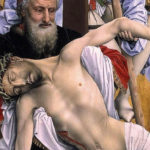
Section of The Descent from the Cross, Rogier van der Weyden, c. 1435

Cogitating beyond pedestrian life, some persons have looked for routes that lead to spiritual thinking and objectives, even if the objectives and thoughts are conjured, unknown and/or contradictory.  There may be an inner feeling in most persons that there is God because there ought to be.  The human mind has worked on it, and come up with the general idea that there is a god – if not God.  Stern humanists have tried to dissuade, but are markedly unsuccessful.  They sometimes despair that they will ever deliver mankind from a god consciousness, even for an ephemeral god, although success is repeatedly prophesied.  Thomas Jefferson was certain the generation after him would not regard god.  They would be enlightened.  Society appears… Read more

Family First

Section of Christ and the Adulteress, Lucas Cranach the Younger and Workshop, ca. 1545–50

I should have caught the trend indications before I did. There has recently slipped into the culture a view about the worn out concept of marriage. A writer in one of the leading newspapers of the nation has raised the point in a clever context. He addressed the drive of the homosexual community for same sex marriages. He asked: Why do they try so hard to keep an institution that no longer has meaning? The growth in co-habitation preserving the independence (identified as freedom) of every individual has been a growing phenomenon. The decline in interest in the benefit of children and family life is a major factor, even driving government to provide services formerly left to the family. Recent… Read more

Love

Section of The Descent from the Cross, Rogier van der Weyden, c. 1435

By way of reminder from other of these Pages, love as God has it for us is generated, in its maturity, in the will.  Romance is dominated by the emotions, revealed in mankind by physical attraction.  The attraction to anything can settle into addiction to something – physical/nature (body, beauty, sex, drugs, wealth, power, or whatever).  Scripture tends toward identifying this as the world (human involvement in nature).  Addiction may become all-the-world for the addict.  It can be found anywhere in the appetites, even in vacuous religion.  It may be in a job or an object like culture as in arts or music.  It tends to demand satisfaction for the person, and may have mysterious forms of gratification.  Genuine love… Read more

Context

Section of The Infant Jesus and St. John the Baptist, Guido Reni, n.d.

Those following these Pages find several vital repetitions: context (complexity) for life; divine (spiritual) and common (natural) grace(s); understanding and knowledge (wisdom incorporating both natural evidence and divine revelation in faith and practice); righteousness and sin as practical issues for both mortality and immortality; culture and Christ-likeness as factors (righteousness and service to others as major work) to be modeled in the Christian life; and, several other lesser, but important emphases, most of which are subsumed under the above areas for consideration and discussion emphases. The age in which this is being written will likely be known, if history proceeds, as the Scientific Age.  Science dominates both the educational/sophisticated world and the lives of ordinary citizens, many of whom could… Read more

Religions

Section of The Crucifixion, Pedro Orrente, ca. 1625–30

To defend one’s faith through physical force or threat, unwarranted by love, is to deny the meaning of the love of Jesus Christ – as demonstrated in the events related to the capture, and ultimate crucifixion of Jesus.  In the aggression of the soldier to take Jesus, the disciple Peter drew his knife and slashed at the soldier.  In the clumsy act, Peter simply cut off the ear of the soldier.  Perhaps the soldier was garbed so that his helmet and other protection prevented Peter from a more offensive thrust.  Jesus caused a temporary pause in the main event, reprimanded Peter for violence and misunderstanding of God’s way of doing things, and healed the ear of the soldier.  Peter may… Read more

Perishing

Section of The Crucifixion, Pedro Orrente, ca. 1625–30

An important learning for all persons is that success and failure, appearances of blessing and cursing, must be seen in meaning for experience and faith.  The following are several undeveloped ideas, so limited to a single page, in beginning discussion related to this troublesome concept.  Awards/rewards are made at the end of a matter, when winning or losing has been determined in the conclusion of the project measured.  Winning in life, which is the objective and deemed worthy of the effort is attended by torture of weariness, of out-of-breath feelings from giving self, of growing skill and extra commitment (zeal) – all need external support, guidance from a coach, and balancing factors.  It is presumed that the expected fulfillment is… Read more

Mystery In Trinity

Section of The Taking of Christ, Caravaggio, 1602

Scripture without evasion or apology, states that Christian faith embraces mystery – an unfinished story.  Further, the implication is that we will not find enough evidence in nature to solve that mystery.  It is to be accepted, and personal faith is to proceed, finding proofs in that processes work for those with genuine faith.  The most important factors in life, like love, are incapable of nature’s proofs, but we see the mystery of both the separate factors of physical and spiritual life, and the whole of life.  Some of the understanding of the mystery is that love generates from the nature of God.  Mankind does not manage it as well as we ought, but we sense affirmative possibilities for those… Read more

Final Word

Section of Christ and the Adulteress, Lucas Cranach the Younger and Workshop, ca. 1545–50

The matter is seldom focused in discussions, that the New Testament is the last word for its divine theme.  Everything else on the theme is presumed to be embellishment of the meaning of this Word.  Since it is the last word, the reader is informed to consider it, live by it as it relates to life, but, in any event, go on with life as one designs his/her own context for it. (Revelation 22:11)  Not only is it the last word, but there are various aspects of the matter worthy of accent and repetition.  The words of Scripture are not to be added to.  They are not to be subtracted from.  So, writes John, Live with that.  To add or… Read more

Intentionality

Section of The Taking of Christ, Caravaggio, 1602

A problem faced in America is that the legal status of religious freedom has not been rightly interpreted, so confuses about addressing the personal needs of citizens.  It has, to some degree, turned on those who are supportive of it.  Religious freedom has been distorted in society in attempting: 1) -to get rid of religion, or reduce it, or find some elusive substitute; 2) -to make religion and the state conflicting entities of each other; 3) – to confuse mankind on the meaning of one God; 4) -to distort religion by the errors found in religions; and, 5) -to imply that religion may be nice, but not necessary.  In general, freedom of religion ought to imply that there is an… Read more