Daily pages of reflection...for knowledge, understanding, to wisdom
Section of The Last Supper, Leonardo Da Vinci Section of The Last Supper, Leonardo Da Vinci

Human and Divine

I devote considerable time to sifting through common and divine grace.  That is to say I cogitate on mankind, under God, but limited to nature’s ways – which is common grace.  I am more interested in divine grace which is man in nature, but with primary citizenship in the Kingdom of God, and so under the government of the one who manages God’s kingdom.  Although common grace is under God, it seems largely manipulated by mankind in pursuits guided by various motivations including the human mind, aggression, and conflict brought on by mankind’s competitions for life’s individual and corporate contexts.  Even if one does not acknowledge God, God is his or her best friend in the natural world.  That friendship… Read more
Prognostications

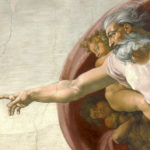
Section of Sistine Chapel ceiling, Michaelangelo, 1508-1512

Christians ought to be citizens of the world, with a steady-as-she-goes attitude. (Revelation 22:11) There are various ways in which this may be taken in discussion.  During recent months (2011) there have appeared numerous references, from varied sources relating to fields of prophecy.  Synonyms include guesses, ancient views, trend interpretations, and others.  A few deal with idealism, but more suggest either unhappy circumstances, or that the future will be ended with the close of time and the dissipation of energy.  Some include the disappearance of necessary elements in the support of human life, such as the end of fuels, of necessary metals, or the inability to feed the population.  This last will already be a serious problem, say the computer… Read more

Thinking Outside the Box

Section of The Infant Jesus and St. John the Baptist, Guido Reni, n.d.

It is important to remember that a person is always being educated, either formally or informally.  We say formally when one is following a deliberate program that provides information, processes, perceptions, and discovery.  We feel it is best when it provides a process or body of information that leads to life improvement and problem solving.  It may be education that ends with divesting the student of some factors.  One can unlearn.  It is important that to gain wisdom one must have the discipline to evaluate the input he or she is receiving and giving.  When carefully done and practiced this amounts to functioning in a context of wisdom.  Wisdom is rightly formulating conclusions from daily learning (experience, both formal, which… Read more

Models

Section of Noli me Tangere by Hans Holbein the Younger

The Hebrew word for father, Abba, is the first word in my Hebrew concordance.  This morning is Father’s Day in the year I am writing this Page.  It is Sunday as so many of these idealistic days for family and society are designated.  Sunday turns out to be serious choice, inviting spiritual interpretation.  There was an excellent program on television today that tended to focus on fathers, and their children, with ancillary attention to women and mothers.  Seems fair to compare or contrast programs and news about mothers and children on Mother’s Day.  The highlight of the program was the story well illustrated of the relationship between Bill Gates Sr. and Bill Gates Jr.  The segment’s conclusion was, as it… Read more

Fact Play

Section of Christ and the Adulteress, Lucas Cranach the Younger and Workshop, ca. 1545–50

Key to discovery of nature’s truth is found in what is commonly called the scientific method.  Begun with some issue (question), the searcher develops a theory (hypothesis), and begins procedures (research), to discover facts that are verifiable to attentive persons using proper processes.  From this methodology an appropriate statement (conclusion) is made that focuses the project – as far as it has gone.  The conclusion may introduce new questions which must be addressed by similar process, if final statements are to be made – statements both affirmative and negative.  Miracles, if miracles are real, do not fit the scientific process as it is expressed in its current structure of the discovery of nature’s truth.  Exclusively humanistic scientists likely do not… Read more

Passages for a Day

Section of Noli me Tangere by Hans Holbein the Younger

Morning Passages: My mind today is on my son-in-law, David, who is having heart surgery.  At the height of his ministry in a thriving church in southern California, he must pause for a sensitive surgery, or without miracle, an untimely death.  Having been through life-extending surgeries, I feel strong empathy for his ordeal today.  His wife, Jody, the youngest of my four children, will have a difficult day today – as her sister, Sharon, had a difficult day more than a decade ago when her husband, also a minister, had open-heart surgery.  So will the David/Jody children, one of whom I wrote about on this day in Volume 1.  In passing time, the son completed his studies for a B…. Read more

Science and God

Section of The Taking of Christ, Caravaggio, 1602

Today I have been mulling again over the views of Stephen Hawking, the physically limited scholar dealing with the great questions of space and stuff.  Hawking’s health is in serious decline.  The prognosis was made long ago, but he survives.  He attracted attention, not only from his creativity in studies, but because of his creativity in facing his personal ordeal.  He began his career acknowledging that the start-up of creation came from God, but he gradually moved to doubt, to deism, and, at this writing appears to deny any divine intelligence.  He now takes some umbrage at Isaac Newton’s claim that an intelligent and powerful being formed the universe.  The key to Hawking’s final statement came, as he writes: …. Read more

Enemies of Self

Section of Adoration of the Magi, artist unknown

I tuned into a popular mid-day television program, entitled Dr. Phil.  The counselor gained his celebrity status as a segment of the Oprah Winfrey show that had dominated in day programming until her change in business interests.  His segment was spun off on its own.  It is one of those too few shows that make contribution to understanding of self, and the options available to better personal relationships.  It has a ring of reality to it, addressing any factor from drug abuse to common patterns in the culture that alienate persons, and interfere with the ordered life.  It is usually a well formed program using excellent production to advance a point for the day.  In this there is something of… Read more

Atheism and Theism

Section of The Taking of Christ, Caravaggio, 1602

The verse does not seem to me to teach that all persons who are unbelievers are fools.  If one is a fool, in the biblical meaning of the word, he or she is not as likely to believe in God, but many fools do believe.  The statement is generalization, something that is common to language usage.  Not all fools will be unbelievers, though that identifies those who do not find some faith, or refuse to do so – since faith is vital to life, whether earthly or heavenly.  One of the problems with many criminals is that they have no faith in human beings, or institutions, perhaps in themselves.  (Arrogance is not evidence of faith.)  Unbelief is a mark, evidence… Read more

Criticism and Evaluation

Section of Noli me Tangere by Hans Holbein the Younger

In the vocabulary of a child the word let means permit: Let me go with you.  In the vocabulary of a tennis player it means hinder: That is a let ball.  Those who know tennis immediately understand that the ball was hindered by touching the net edge rather than going over it without impediment – same word, two meanings.  Those who are pedestrian in their language often understand the word criticism as faultfinding.  It is related to gossip, to maligning, to jealousy, to one-ups-man-ship conduct.  To the truly sophisticated researcher or objective person it is evaluation for right and wrong, for true and false, for better and poorer.  The ultimate end of criticism (evaluation) is to learn what is true… Read more