Daily pages of reflection...for knowledge, understanding, to wisdom
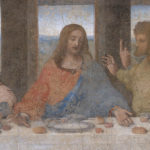
Section of The Last Supper, Leonardo Da Vinci Section of The Last Supper, Leonardo Da Vinci

Spiritual Projection

Section of Christ and the Woman of Samaria, Benedetto Luti, 1715-20

Well educated humanists/secularists often take the idea of life after death as a wishful concept.  It gained considerable agreement and strength after Freud.  He tended to take preoccupation excess that could not be accounted for in the logics of physical science and attach it to the machinations of the mind.  Religion became a neurosis, and was to be treated as such.  So it became the belief, made somewhat official, that we are fooled by our minds in wishful thinking about life after death.  The point darkens further when hell is the topic.  Would we identify hell as wishful thinking?  The magnificent (heaven) is balanced off by the unthinkable (hell).  How could the imagination, willing for the comforting concept (heaven), come… Read more
Integrity

Section of Noli me Tangere by Hans Holbein the Younger

We are today interested in clarifying thoughts about models and integrity.  Scripture is rather stern about concepts of modeling and acting with integrity.  The emphasis here will be a shift in context for the theme.  One of the prevalent values, never deviating from its norm in Scripture, is that a person should follow a course of biblical righteousness, which includes the model (example setting) attitude and mental persuasion to that culture.  To seek righteousness is not simply to practice doing the right in truth in oneself and with others, but the offering of clear and instructed conscience for belief and conduct.  There is a consistency so that the individual is found in character – in what may be identified as… Read more

Ol’ Folks and Life

Section of Adoration of the Magi, artist unknown

In reading articles about aging populations one tends to smile at both the young and old in trying to address the issues, for instruction and action.  What words do the writers use to refer to their elders?  The elders themselves seem uncertain about what term or terms they prefer.  One is almost tempted to avoid addressing the concerns and needs of the elders because of the nature of the context that requires withdrawal and focus on endings.  We attach so much of political correctness to public life that we may omit important information about what ought to be done.  On earth, the aged belong to their families. The problem is partly intensified because the more youthful generations have taken over… Read more

Heart Phrasing

Section of Noli me Tangere by Hans Holbein the Younger

There is, within the human heart, desire to encapsulate (to simplify).  It is a basic tendency that affects thought and action.  That which goes beyond the encapsulation is fraught with sophistication, danger, awe, above averages, and perhaps with mystery.  These factors may be small, because the matter at hand is small, but they may be (and often are) large, complicated, troubling to us.  To go beyond the capsule (simplification) may be invitation to adventure, risk, opportunity, even danger.  It may require increased knowledge, skill and responsibility, perhaps related to gifted leadership with investment of self and resources.   Capsulating (small contexts in the larger context) helps busy persons, or those who believe they are, to get on with life and manage… Read more

Art to Spirit

We need to remember, if we ever knew, that human living is more an art than a science.  For the stern scientist, life is physical, governed by the laws of nature.  Find those laws, adjust to them, and do whatever may be done to assist them, so to find health, comfort and length of days.  This is nature’s reality.  Concepts related to human and spiritual aspirations are usually seen as additions created from human consternation over life-ending.  Science, in the medical context, is the way to go – they say.  So it is that mankind becomes the measure of science.  Values are to be found, if values are a regard, in whatever improves mankind’s situation.  Good is found in health… Read more

Honor and Majesty

Section of The Taking of Christ, Caravaggio, 1602

There is some majesty in righteousness.  This may be illustrated in various ways related to human conduct and thought.  We here use the matter of sexual perceptions and conduct.  If kept within a boundary of righteousness, sexual activity is rightly perceived as having high objective for both the purposes of reproduction and the fulfillment of inherent physical drives.  This last is often referred to as recreational sex.  It is more than that, but it is also that.  Following biblical ethics, we presume that practice of any sexual behavior, related to orgasmic response, even prevailing thoughts of it, relate in some way to spiritual values and touch in various ways on practical human conduct.  There is a right and wrong context… Read more

Holy Spirit

Section of Christ and the Adulteress, Lucas Cranach the Younger and Workshop, ca. 1545–50

I am not a charismatic Christian as that word is usually defined in theological discussions.  In the Christian theological context that means I have not experienced the Holy Spirit in the way that he expresses himself to me by speaking in tongues, or, for some persons, a special event that may include evidence of language ecstasy and may be identified by some as a second work of grace.  The first work in this context relates to redemption through the personal confession of sin and the fixing of faith on the work of Jesus Christ in his substitutionary crucifixion and resurrection.  Although I am not Pentecostal, I have devoted friends who are, and we fellowship well in shared Christian faith and… Read more

Joy in Faith

Section of The Last Supper, Leonardo Da Vinci

Joy is an important biblical concept, and ought to gain more attention than it does.  It is more meaningful than its pleasant, modest reputation affords.  We refer to joy at Christmas even putting the three letters in ribbons, usually red, on Christmas trees, or along the wall.  We may catch it when a child exults over a toy.  Joy becomes a toy at Christmas, for small children, and vicariously with them for adults.  Joy is sung at Christmas, and often put away with yule trimmings.  Bills will follow.  Joy is a touch of heaven to us. We might wonder about joy.  If I go down the street with solemn, even troubled, mien, the passers-by accept that solemnity as the normal… Read more

Conditioning

Section of Adoration of the Magi, artist unknown

When a communication process is pressed upon me over and over, to a purpose I find I do not want, I feel I have been brainwashed.  That is, if I succumb to the pressure.  However, if there is a value I ought to keep, and I welcome the repetitions, I fortify my resolve.  For example, I always feel strengthened to repeat, perhaps in a church service, one of the ancient major creedal statements of Christianity.  The arrogant Gnostics were largely marginalized by the Christian creeds.  I have read several personal statements of persons who reviewed creeds often so to render indelible the self-challenge to meet the objectives of their natural and spiritual lives.  Wise persons informed us that repetition is… Read more

Value

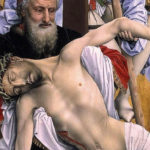
Section of The Descent from the Cross, Rogier van der Weyden, c. 1435

What is the worth of a person?  Jesus put the value as greater than the world. (Mark 8:36; John 14-18)  In Levitical law, cast so to settle natural issues of mankind in human culture and borne from justice related to righteousness, a child could be valued for a certain amount, and an old person for another.  Between the ages of twenty and sixty years (between youth and age), the value was the highest signified.  A male was valued at fifty pieces of silver and a woman at thirty. (Leviticus 27:3 ff.) Jesus was given the worth of a female (a reduction in cultural or economic value in the ancient patriarchal mind).  That amount was the determination of the priests in… Read more