Daily pages of reflection...for knowledge, understanding, to wisdom
Section of The Last Supper, Leonardo Da Vinci Section of The Last Supper, Leonardo Da Vinci

Work That Lasts

The concept of work relates some of the meaning of earth and heaven.  Formed in God’s image, we learn from Scripture that because God works, we also work.   We learn from Jesus’ words that presented his own goal and purpose as work, given of the Father.  A block passage explaining some identity and extent of work is 1 Corinthians 3.  It teaches especially the importance of work as a spiritual factor.  The reader is given the caveat, well known to evangelical Christians, that mankind’s work is not a ticket to heaven (v.15), but does not deny that work for human survival is necessary and important.  There is necessary work that is virtually meaningless to divine grace.  That which is done… Read more

Learning Limitations

Section of Adoration of the Magi, artist unknown

I was warmed in reading several articles about Calvin Borel in 2009.  That year he suddenly became a bona fide celebrity in the sports world for the season.  Borel, 42 years of age, from a small community in Louisiana, came from a poor Cajun home, and had almost no formal education.  In middle age, he asked a friend, an elementary school teacher, to teach him how to read and write, and carry on a conversation.  He, at 41 years of age, became, at least for a short season, the most famous jockey in the world.  At his request, he was awarded the mount for the Kentucky Derby, a filly named Mine That Bird – a 50 to 1 shot to… Read more

Life in Two Dimensions

Section of The Infant Jesus and St. John the Baptist, Guido Reni, n.d.

In any discussion about living and dying, there should be a check on prognostications and analyses in the acknowledgment of the providences of God.  We differentiate several functions of God so to allow for common grace and divine grace.  Common grace is available to all, and God, in love, responds to all persons, devout or profane, in many ways and patterns.  In divine grace there is special consideration.  The miracles of Moses, or Elijah, or Jesus, or the Apostles, and others in all eras are miracles of God.  The first, providence, is commonplace: the second, miracle, is beyond nature appearing seldom or in clusters as with Moses or Jesus.  For example, if a person were to survive an accident in… Read more

Practical Formation

Section of The Taking of Christ, Caravaggio, 1602

It is clear to anyone following these Pages that I am much taken with family.  These Pages are first meant for my own family generations, and to those I feel make up my family of students, persons who came my way in professional life and preparing for life experience and service.  Since then these Pages have spilled over to others outside my first audiences, to those of my invisible congregation.  The purpose has become a focus on spiritual, educational, personal insights – related to both common grace and divine grace. Family, man’s first institution under God, is God’s favorite analogy in Scripture, related to life – mortal and immortal.  The family of God is used as a major analogy of… Read more

Education and Values

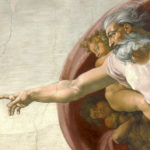
Section of Sistine Chapel ceiling, Michaelangelo, 1508-1512

I feel strong urges to write about thinking, values and wisdom relating to Christian faith.  Issues can be addressed simply at outset, but become complex and evasive as we get into them.  Solomon rightly related wisdom to the process of thinking (theorizing), testing (experimenting), and acting (doing).  This essentially puts the educational method to work, but Solomon would incorporate more than other teachers might include.  In that larger inclusion he would think values before science or engineering.  Early in my educational interests I thought that right thinking would tend to focus similar conclusions for us.  I now believe that the most insightful writers on thinking, attaching rightness (values), to verbal truth leading to response (assertion and action), succeed in showing… Read more

Evening of Imperfection

Section of Christ and the Adulteress, Lucas Cranach the Younger and Workshop, ca. 1545–50

It was a crisp December evening in 1950 in Times Square, New York City.  We watched with more than one million others in that Broadway district as the electric ball fell to usher in 1951. I remember my euphoria about what the future might be, for me, my family and country I loved, and for the world.  Matters could be better.  The lengthy years of cold war tension between the Communist world and the west were on us.  The Korean War was in full armor, even though the devastation of World War II had not yet been totally cleared.  The Great Depression was over.  Pressures were building for greater equality for races, for women, and for disenfranchised persons.  Various issues… Read more

Double Life

There is a sense in which Christians do live a double life – a difficult matter.  Many, possibly most, seem not to be comfortable with this tension.  The inner conflict, a major paradox in the minds of analytical Christians, even for casual laymen, is a mystery for many.  They need to give attentive study to the middle chapters of the Romans Epistle.  The Apostle admits his own struggle with the causes of inner conflict, summarized in the words, law and sin.  He discovered sin from the affirmations of God’s laws that identified sinful nature and behavior.  He even recognized the seeming contradiction, actually a paradox in which that which helps liberate people, the Law of God, is also a shackling… Read more

Old and Satisfied

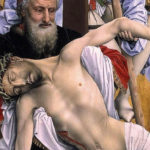
Section of The Descent from the Cross, Rogier van der Weyden, c. 1435

As the calendar year ends, elder analysts in society cogitate a bit about the end of life.  The thoughts do not emerge dramatically, but gently: Will I be here this time next year?  Will I be ambulatory, and able to care for myself?  Will the few matters that mean something to me remain available to my life?  The questions follow in that vein for an elderly person. The Bible represents old age as a gift from God, and the result of a good regimen giving strength (health). Psalm 90:10.  But, it also notes that even when life is lengthy for an individual, the whole of it is short, and challenged with toil and trouble.  While length of life is perceived… Read more

Change in Order

Section of Noli me Tangere by Hans Holbein the Younger

We know that dramatic and meaningful shifts have occurred in history that changed the world.  It is said that an asteroid hit the earth in the present area of the Gulf of Mexico 65 million years ago, changing the earth substantially, destroying large animal species like the dinosaurs.  It is presumed, as noted on other of these Pages, that such an event will occur again sometime in the future.  But catastrophes do not capture our attention here.  Alone, the human population can do little about nature’s furies.  We are concerned with those large movements that change the earth for good or ill that might be influenced by mankind, some through prayer, prayer needed to help resolve intersecting and conflicting factors…. Read more

Jesus Of History

Section of Adoration of the Magi, artist unknown

Christmas, so recently celebrated, is when Emmanuel (God with us) becomes not only a spiritual reality, but physical as well.  What was believed in faith about the gift of God, the Messiah, became someone: we have seen . . . we have touched . . . we have heard.  (1 John 1:1)  From that period until the present, sincere believers and variant scholars have sought the historical Jesus.  That is they are trying to find out all they can about who Jesus was in his flesh, his thirty three years of earthly sojourn.   Theories conflict with each other, with many becoming forays in unsupported assertions.  Some have this teacher of marital fidelity and Mary Magdalene entering intimate physical relationship.  One… Read more