Daily pages of reflection...for knowledge, understanding, to wisdom
Section of The Last Supper, Leonardo Da Vinci Section of The Last Supper, Leonardo Da Vinci

Jars of Clay

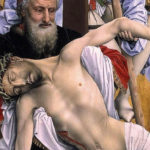
Section of The Descent from the Cross, Rogier van der Weyden, c. 1435

Christmas Day was ended.  The gifts had been distributed.  The plenteous repast was at least partially digested.  Gift wrappings were trashed and the kitchen restored to order.  The happy day was closed, and we were at peace.  As my wife and I entered our bedroom for the night, there on the corner of the dresser, was a standard 3×5 card with the words: Mom and Dad,  On this Christmas night, 1974, I give you 2 Corinthians 4:7-10. I love you much, Jody.  Forty-plus years later I have no recollection of the other gifts so graciously given that day, or even the meal, although I can fairly well presume what it was – by what Jody’s dear mother did for decades… Read more

Born On Purpose

Section of The Taking of Christ, Caravaggio, 1602

Asked to speak to a home group just before Christmas, 2002, I was offered excuse for whatever I would say: Although you are to speak about Christmas, I suppose there is nothing new that may be said about the topic.  That idea stuck with me, and I thought that there was so much to say about it that we could not have said it all, and/or that there was so much that we had forgotten – so to say it in a different context might revive intensity of meaning for the most recognized holiday of the year in western nations.  On that evening I went from person to person and asked what they would be if they had choice to… Read more

Captain of Peace

Section of Christ and the Adulteress, Lucas Cranach the Younger and Workshop, ca. 1545–50

There is little doubt about the prophecy of Isaiah – that this reference is to the Messiah, who is seen as the coming ruler of Israel.  In western culture, we may lose the impact of the words of Isaiah.  The phrase in the King James Version (KJV) is not fully clear.  The words, Wonderful and Counselor are separated, as though both are nouns.  Translators missed the parallel structure they adopted for the other parts of the verse.  (Even Handel’s librettist got it wrong.) This person Isaiah describes would be, if we may be so bold as to correct the scholars, a wonderful Counselor, mighty God, everlasting Father, peaceful Prince.  The English Bible (NEB) states: in purpose wonderful, in battle God-like,… Read more

Gift Giving

On an occasion in Alberta, Canada, I was with a friend in his father’s store.  On the shelf was a small pair of cowboy boots.  I deeply desired those boots for one of my grandsons, but could not persuade myself to purchase them.  The significant cost was equal to that for boots fitting an adult.  On returning to his home, my host handed me the little boots in a tote bag: You wanted those boots very much. They’re yours. I wondered how he could know that I wanted those boots.  I had said nothing, and did not know that anyone had observed my lonely preoccupation with the shoes.  He backgrounded: When I was in South America, I learned a grand… Read more

The Lamb

Section of The Infant Jesus and St. John the Baptist, Guido Reni, n.d.

It is the Christmas story.  Mary had a little Lamb.  His fleece was white as snow.  Everywhere that Mary went.  That Lamb was sure to go.  And he goes with anyone who will accept, to quote John the Baptist: the Lamb that taketh away the sins of the World.  In the Old Testament we are lambs: in the New, Jesus is The Lamb of God.  God, the Shepherd, lived the life of the lamb. It was January 1944.  I turned 21 years of age that month.  I had married the previous September, and was happy with my new bride.  I was the pastor of a little church in Nebraska.  Everything was new to me.  The boy had to become a… Read more

Information

Section of The Descent from the Cross, Rogier van der Weyden, c. 1435

We remember that Mary was sixteen or so years of age when she became pregnant.  Sixteen was a common age for girls to marry.  Pregnancy in mid-teens in the ancient world was common.  In traditional patriarchal homes, girls were well taught from early years, what their role was to be in intimacy with their husbands; in the care of the home; and, in the rearing of children.  That was, for the vast numbers of women, the whole of their natural lives.  By current standards, adolescence holds during the teen years, and, during my lifetime, has extended into college years.  If we nurtured our children as the ancients did, we might modify our current opinions. As a father of two daughters,… Read more

Humility

Section of The Crucifixion, Pedro Orrente, ca. 1625–30

A Christmas song is entitled, Mary Did You Know?  It has a gentle haunting quality about it, both in tune and poetry.  It comes more from man than angels, but emotionally warming for the Christmas story.  The song is another evidence of desire in persons to find someone between God and mankind through whom a person can talk about God, or to him.  The Catholic Church makes this inclination a part of its doctrine and liturgy, so venerates Mary.  Some persons take the matter so far as to equate Mary with Jesus.  Protestant Christians find, in Mary, great virtue and devotion, but do not venerate her above humanity’s best limitations.  This last can be important if we are to find… Read more

Epiphany

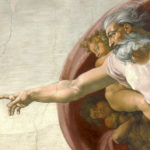
Section of Sistine Chapel ceiling, Michaelangelo, 1508-1512

A circle of prayer is completed in any answer to prayer.  Prayer is only partly addressed in the requests of the persons at prayer.  Does God answer back in the sacred conversation?  Scripture informs us that he does.  One would seem foolish to talk to God about problems, interests and worship, and nothing be done about the words and ideas, mingled with faith and authority, as expressed by the devout.  The magnificent piece by Dick Anthony, O Speak to Me, to the music of Chopin expresses the concept of the yearning of mankind for God to communicate.  Scripture represents numerous occasions in which God spoke to persons, sometimes repeatedly to an individual.  It is unlikely that God ever spoke to… Read more

Gifting

Section of Noli me Tangere by Hans Holbein the Younger

For some years, each Christmas I focused on a different perception of the season.  I selected characters from the Christmas story.  The various series seemed to be productive for increased devotion.  One year I conjured the thoughts of Joseph, on another the shepherds, on another Mary, then the innkeeper and the Magi.  Some years I returned to a person I had studied years earlier.  This year I took ideas from Christmas songs based on selected phrases without serious regard for their contextual lyrics.  Some were found in enduring Christmas hymns, while others were lifted out of songs popularized by the season.  Some were basically secular in nature, but intended to catch the spirit of the Holidays (Christmas) – whatever that… Read more

Libations

Section of Christ and the Woman of Samaria, Benedetto Luti, 1715-20

Drinking wine was common practice in Israel.  Cultivating vineyards and making wine were major industries for Israel through much of its ancient history.  Apparently God did not disapprove, except in violation of moderation.  The general culture assumed the uses of wine, and looked upon teetotalers as odd, perhaps disconnected from society.  At the same time the leaders of Israel warned generations of dangers in drunkenness, not merely because it robbed an individual of control of his senses, but also caused other negative effects.  The wine analogy, in this chapter from Jeremiah, was not reporting about wine, but on a marginal cultural fact that a father of the Recabites, Jonadab, ordered his sons and descendants to never drink wine.  Loyal to… Read more