Daily pages of reflection...for knowledge, understanding, to wisdom
Section of The Last Supper, Leonardo Da Vinci Section of The Last Supper, Leonardo Da Vinci

Hell

Section of Christ and the Adulteress, Lucas Cranach the Younger and Workshop, ca. 1545–50

For many persons, the most difficult doctrine of the Bible is the doctrine of hell.  Jesus gave considerable time to references about hell.  The issue was not hidden in a corner, or evaded in the ministry of Jesus.  Modern human beings have difficulty managing any idea of hell, even if it were temporary, much less eternal.  Jesus’ references to hell come close to matching in number his references to heaven.  If Jesus had not given his affirmation of hell it is not likely that more than a few would believe in such a place.  The unbelieving tends to hold to the idea that one falls asleep in death, and never awakens, commonly called eradication or nihilism, or soul sleep.  Such… Read more

Signs

Maturing persons, who are also attentive, learn to read signs pointing to impending problems and benefits – in some contexts which they share with others.  Those cooperative persons are most wise, and possess the leadership needed for the moment, to reduce the negative factors and embellish the affirmative.  The Bible suggests that one of the tools for living, in an orderly context of life, belongs to wisdom relating to future experience.  It may seem prophetic, but society expects such insight, especially from its leaders.  Without attention and application of perceptions related to currency, wise persons likely do not serve much better than those with limited insights.  Wisdom ought to be related to modest prophetic insight. When the revered Joseph Paterno,… Read more

Forgiveness

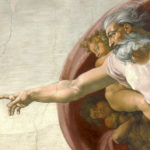
Section of Sistine Chapel ceiling, Michaelangelo, 1508-1512

Several media programs have recently given major attention to forgiveness as a solution to some human problems that plague not only individuals but society in general.  They do not relate the concepts and results to spiritual sources, and may not believe spiritual involvement is helpful to their understanding or purpose.  They would interpret the matter with documented studies showing forgiveness to be an effective solution to many human problems.  I would contend that forgiveness originated with God, giving a source reason to believe – to believe that something important to us ought to include spiritual motivation helping to make it effective and lasting.  Forgiveness, a vital factor in the Bible to qualify for heavenly citizenship, is foreshadowed in forgiveness as… Read more

Distorting Change

Section of The Taking of Christ, Caravaggio, 1602

Easter came late in the spring, in 2003, and even later in 2011.  Some persons get hung up on the statement that Christ crucified on Friday, and risen on Easter Sunday, was presumed to be in the grave for three twenty-four hours’ days before resurrection.  If Friday (late) and Sunday (early), how do we get three days?  The likely answer is that in that far off era (culture) any portion of a day was counted a day.  The prophetic meaning is fulfilled in the culture of the time if Jesus expires a minute before the Sabbath begins, and rises a minute after the Sabbath ends.  The schedule may not have been kept that tightly, but might have been.  Time is… Read more

Afterwards

Section of Sistine Chapel ceiling, Michaelangelo, 1508-1512

In discussing Christianity as either theory and/or experience there are several variables that ought to be openly acknowledged, with toleration if not agreement among the discussants.  This is especially true for the members of a family, often divided by identifiable words like Catholic, or Orthodox, or Protestant, or Charismatic, or Evangelical – perhaps by some other symbol.  The differences among the various groups have created conflicts among them – sometimes to hatred and bloodshed.  Whatever the differences, the Prince of Peace and Love never meant that it should be so.  The warfare is internecine, which, in historical eras means simply that the battles occur among or within those presumed to be of the same family.  Catholic scholars may pass off… Read more

Easter Sunday

Section of Christ and the Adulteress, Lucas Cranach the Younger and Workshop, ca. 1545–50

Easter is a Christian holyday/holiday. No other religion has a parallel to it. Christianity is not filled up without Easter – the Resurrection. Christmas became the answer to pagan rituals of the solstice, occurring in the northern hemisphere. The Sun was returning. The colder habited climes celebrated the event of coming warmer weather, fruits of the field, the animation of light in longer daytime, and the indications of ongoing life. Mankind would not flourish if all days were like December 21 in northern Europe, where solstice was a major celebration. The church may have countered pagan practices, like solstice parties, with accounts of birth stories of Jesus. Even marking Jesus’ birth sometimes held disrepute in the church. A person in… Read more

Paradox or Contradiction

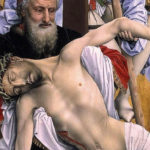
Section of The Descent from the Cross, Rogier van der Weyden, c. 1435

This Page is being written on April 12, 2011.  The date, a week ahead of the above date, is prompted by my reading of a book review in the Wall Street Journal, with the byline of Andrew Stark.  He reviewed a recent book, Obliquity, authored by John Kay.  I was highly impressed by the analysis.  (I tend to follow, in ensuing years, the topic text of the same date in previous years.  This one fits here.)  Anyone knowing my intellectual/spiritual bent knows that one of my preoccupations is with issues related to paradox and contradiction.  (Similar preoccupation weighed on Einstein, who did not posit God for resolution.)  This book is an excellent illustration of how we, as human beings, may… Read more

Discipline’s Way

Section of The Taking of Christ, Caravaggio, 1602

At the time of this writing there is a brouhaha that has arisen in the news industry about child discipline.  The high interest has grown out of a rather firm feeling that American youths have not been adequately disciplined in their families, as detected in evidences lumped together in the password, lifestyle.  This includes nearly everything related to conduct and attitude – shallow education, slovenly manners, carnal culture, debilitating early habits, rising obesity affecting health and achievement, and the like. The massive problem is a serious threat to balanced life – so to weaken it.  This does not deny that youths in majority are doing well in forming their lives, and parents doing their loving duty.  Failure rates remain too… Read more

Orienting Life

Section of The Infant Jesus and St. John the Baptist, Guido Reni, n.d.

The common pattern for improvement, for self or society follows an incremental route – little by little we learn, add, absorb, apply, live, love, and function.  Only a few persons have the inner drive, perceptions, skills, brain waves, energy, that vault them forward in large chunks.  Only a few can absorb in short spans, gobs of whatever is needed to advance the intellect, discoveries, contexts of life, nature and growth.  They are so few in number, and sometimes so remote from daily life and society that they must function on the margins of social and personal parameters.  They often seem so beyond the norm degree that they will not make the impact they might hope to make, an impact that… Read more

Demanding Differences

Section of Adoration of the Magi, artist unknown

In midyear, 2011, the California legislature made law that the contributions of homosexual persons must be included in the teaching of history in public schools.  Governor Brown signed the legislation.  It is striking that sexual orientation should be singled out as a deliberate factor in the classroom.  Will it be necessary to identify the sexual orientation of each person, so to gain the objectivity and fairness due each individual?  Should the contributions of criminals, of housewives, of clergy, of any personal identification be singled out?  We learned in school that there were persons who were homosexual in their orientation, principally in literature for us, but only if the genre, often poetry and fiction, related to the feature.  I was assigned… Read more